When it comes to the topic of actors that died too young, one of the first people that comes to mind is James Dean. On September 30, 1955, Dean was killed in a car crash at the age of 24. Although he made only three films (East of Eden, Rebel Without a Cause and Giant), Dean made a lasting impact during his short life, and he continues to influence many today. After I decided to write about James Dean for the Gone Too Soon blogathon hosted by Comet Over Hollywood, I began to think about the different ways that he has influenced pop culture and media, which is what I'll be discussing today.
Dean has been referenced of mentioned in dozens of popular songs, some of them being "A Young Man Is Gone" by The Beach Boys, "Electrolite" by R.E.M., "James Dean" by the Eagles, "Rockstar" by Nickelback, "Speechless" by Lady GaGa, "Blue Jeans" by Lana Del Ray, "These Days" by Bon Jovi and is one of several stars mentioned in "Vogue" by Madonna.
Dean is also recognized in several television shows and movies. On Happy Days, a picture of Dean is seen in Fonzie's closet, another appears on Rizzo's wall in Grease. The show Queer as Folk compares him to music icons Kurt Cobain and Jimi Hendrix ("They're all legends. They'll always be young, and they will always be beautiful"). Dean is also portrayed by actor James Franco in the biopic James Dean, released by TNT in 2001. I haven't seen the film myself, but I've heard several Dean fans praise Franco's performance and most of the film is said to be accurate compared to Dean's life.
Thanks to Comet Over Hollywood for hosting the Gone Too Soon blogathon. Please go check out the other contributions recognizing other actors whose lives ended prematurely.
Here are all the blogathon contributions I've received so far. I'll be updating this post again soon for anyone else who submits their posts over the weekend:
My contribution for the Dueling Divas blogathon at Backlots.
IMDb Synopsis:A young woman dumps her fiancée and runs off with her sister's husband.
I've been contemplating over the last few weeks about which film I wanted to write about for this blogathon. My original choice was The Dark Mirror in which Olivia de Havilland plays twins, but I wasn't able to find it online. Instead, I chose John Huston's In This Our Life which pairs de Havilland alongside Bette Davis.
Davis and de Havilland made several films together, and in most of them they play rivals, as they do here. This time, the reason for their strife being that Davis runs off with de Havilland's husband (played by Dennis Morgan, who I consider to be extremely underrated). Other actors worth mentioning are George Brent as Davis' fiancee and Charles Coburn.
The characters the actresses play in this film are the type of roles they were most commonly known for- Davis is a "bee" with an "itch", and de Havilland is convincing as a kind but strong woman who doesn't let her sister and her husband's actions destroy her life.
Overall, I wouldn't consider In This Our Life to be the greatest of either Davis or de Havilland's work (that's saved for Now, Voyager and The Snake Pit) but they both deliver solid performances and the film is definitely worth watching.
My contribution to the For the Boys blogathon, hosted by The Scarlett Olive.
When I first heard about this blogathon, I immediately thought about men who went against type casting and stood out from other actors of the era. One of these men is Sidney Poitier, a favorite actor of mine. Poitier began acting in the 1950s and has been a significant icon in the film industry ever since. Some of his most popular films include The Defiant Ones, Lilies of the Field, A Patch of Blue, Guess Who's Coming to Dinner and To Sir, With Love, all of which I'll be writing about in this post. I will also be including excerpts from Poitier's autobiography The Measure of a Man in which he writes about each of the films discussed.
In 1958, Poitier starred alongside Tony Curtis in Stanley Kramer's The Defiant Ones. The film is about two escaped convicts, one white and black, who are chained together and must co-operate together in order to prevent capture. Curtis and Poitier were both nominated for Academy Awards- the first time an African American man had ever been nominated (both lost to David Niven). Poitier writes:
"Greed and cruelty are pretty widely distributed throughout humanity, as are their victims. You can have oppression of one sort or another all across the board culturally speaking, and all across the board racially speaking, and all across the board religiously speaking. The down-and-out characters played by Tony Curtis and me in The Defiant Ones weren't willing to give any credence to this commonality until their experience thrust it right up in their faces and they could no longer ignore it. That's why, at the end, they wound up on that railroad trestle, one guy holding the other guy, struggling to survive, hanging on, but singing a song, a song of hope." -pg 103
Six years after receiving his first nomination, Poitier became the first African American man to win an Oscar for Lilies of the Field. Directed by Ralph Nelson and adapted from the novel by William Barrett, the film tells the story of a man (Poitier) that meets a group of German nuns who believe God sent him to build them a new chapel. Poitier writes of his win and the effect it had on him:
"In 1964, I was awarded the Oscar for best actor in Lilies of the Field, the first African-American so honored. Did I say to myself, 'This country is waking up and beginning to recognize that certain changes are inevitable'? No, I did not. I knew we hadn't 'overcome' because I was still the only one. My career was unique in all of Hollywood....When I realized that I could be a better than utilitarian actor, I realized that I had the responsibility, not as a black man, but as an artist, to exercise tremendous discipline."-pg 107
In 1965, Poitier costarred with Elizabeth Hartman and Shelley Winters in A Patch of Blue. Directed by Guy Green, the film is about a blind Caucasian girl (Hartman) who falls in love with a black man. When released, A Patch of Blue caused a great deal of controversy as the United States was racially divided at the time. Scenes of Poitier and Hartman kissing had to be cut from the film when it ran in film theaters in the Southern states (these scenes are included in the DVD version and on Turner Classic Movies' airings). Poitier talks about his mindset while filming:
"...I was dipping into emotional pockets that were new to me. This was a white girl, and we were in 1960s America. This was a revolutionary attempt at filmmaking, so I was mentally awake in every way. I had my eye out, my ear out, and I was quite primed to make sure that nothing untrue, uncomplimentary, or stereotypical occurred. I wanted to make sure that the story was told with dignity and respect for the questions involved. This wasn't the story of an interracial couple, mind you. This was simply a guy trying to help a young girl who was in need. It was a very human story." -pg 110
My favorite of Sidney Poitier's films is Stanley Kramer's Guess Who's Coming to Dinner. Released in 1967, the film tells the story of a white woman (Katharine Houghton) who brings her black fiancee (Poitier) home to meet her parents (Katharine Hepburn and Spencer Tracy, in his last film). This was a groundbreaking point in film history, as it confronted the subject of interracial marriage, which was still illegal in seventeen states at the time. Poitier writes about meeting Hepburn and Tracy before production on the film began:
"The truth of the matter is that the formation of this business relationship was almost a literal "pre-enactment" of the situation in the film we were about to make. The black man was coming for dinner, and we usually didn't do that....They were going to enter into an intense creative partnership in which they would take on one of the primal taboos of our culture, interracial marriage- and 'we usually don't do that,' either." -pg 122
The fifth and final film I'm going to mention is To Sir, With Love. Also released in 1967, this film is about a black high school teacher (Poitier) and his experiences in a class full of white students (Coincidentally, Poitier had played a rebellious student twelve years earlier in Blackboard Jungle). Racial issues are mentioned, but the prominent subject focuses on the teenage angst and the inspiration the students receive from Poitier's character. Poitier discusses the impact his character had on the students:
"By the end of the film he had transformed his class into a group of interesting people, most of whom were thinking about going further in education, most of whom were feeling much, much better about themselves and were willing to give each other the benefit of the doubt, who were able to offer respect and to receive respect quite openly. He did all this for them, but he also showed them that they were still the same people that they had been- only better." pg 188
That's about it for this post. I highly recommend all five of Sidney Poitier's films that I discussed. Thanks to Hilary and Katie at the Scarlett Olive for hosting this blogathon!
As most of you probably know by now, Humphrey Bogart is my favorite actor. In honor of his 112th birthday on December 25th, I've decided to host my first blogathon, which will run from December 23-December 25th. I realize that's it's three months away, but if you'd like to participate, I ask that you let me know by December 22nd. Your post can be about his films, his life or anything else Bogie-related.
Here are a few banners I made to promote the blogathon (feel free to make your own if you'd rather):
Just a few other blog updates:
Starting Saturday, I'll be changing the blog header at the beginning of every month featuring a film that somehow relates to that particular month.
Also, I'll be starting a new "blog series" called My Favorite Films. As the title says, about once or twice a month I'll do blog posts talking about some of my favorite films, mainly focusing on my top twenty for now. I'm planning to blog about a few special films to coincide with the blogathon in December.
If you have any questions about the blogathon, let me know in the comments, or contact me through Twitter.
My contribution to the Fashion In Film Blogathon, hosted by Angela at The Hollywood Revue.
Over the past few weeks, I've been thinking a lot about what to write. As Edith Head is my favorite costume designer, I thought it'd be fun to decide which films/designs of hers I liked best. This is more so ranked on the actresses' whole wardrobe, rather than just one outfit. Also, Angela just posted her top 10 film costumes recently, so make sure you check that out!
10: Olivia de Havilland in The Heiress (1949)
9: Barbara Stanwyck in Ball of Fire (1941)
8: Kim Novak in Vertigo (1958)
7. Bette Davis in All About Eve (1950)
6. Gloria Swanson in Susnet Blvd (1950)
5. Audrey Hepburn in Sabrina (1954)
4. Elizabeth Taylor in A Place In the Sun (1951)
3. Barbara Stanwyck in The Lady Eve (1941)
2. Grace Kelly in Rear Window (1954)
Tried to find a good colored version of this dress...no such luck.
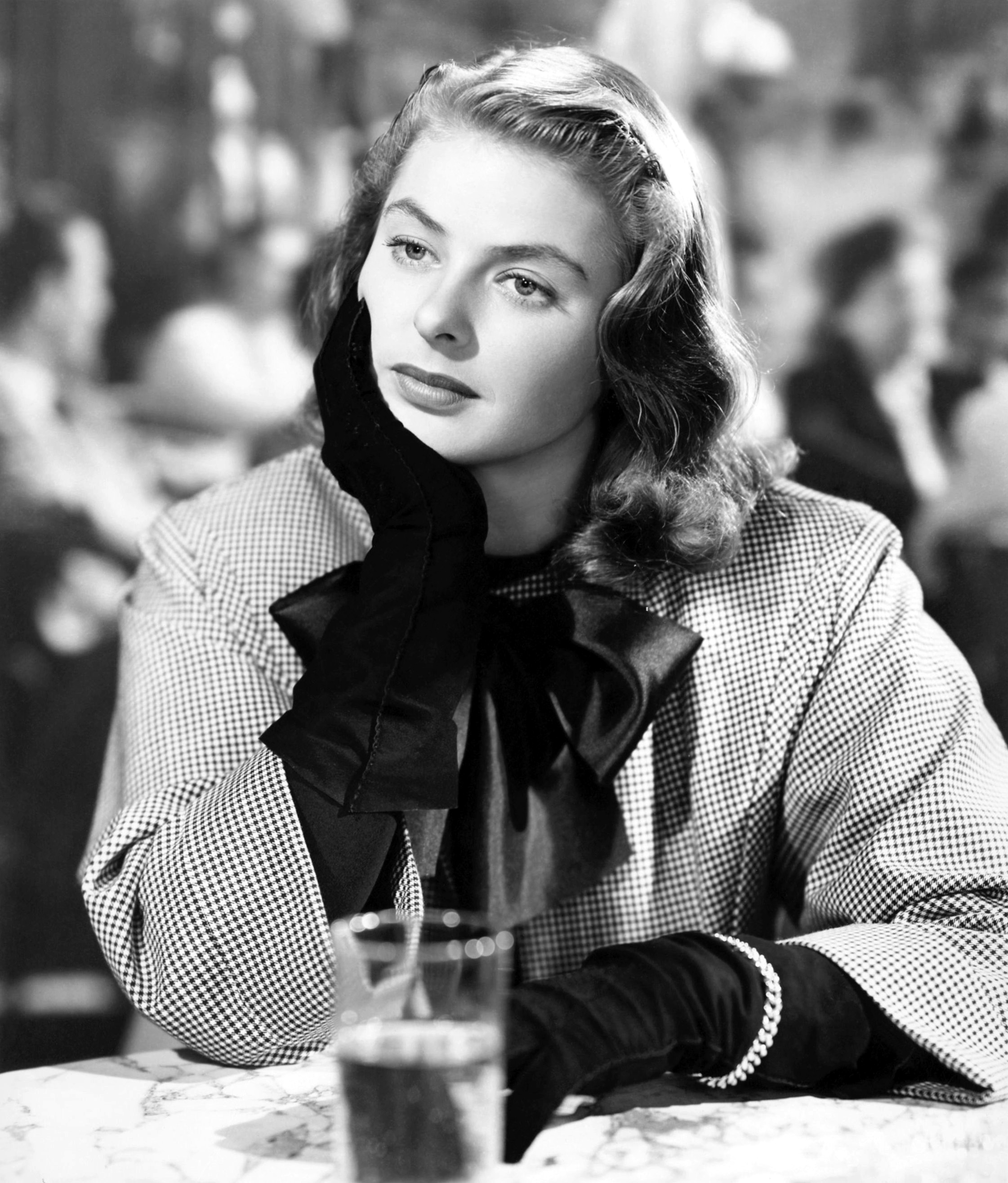
1. Ingrid Bergman in Notorious (1946)
That's it for my top 10 Edith Head designs. A big thanks to Angela for hosting this blogathon!
For my contribution to the Nicholas Ray Blogathon over at Cinema Viewfinder, I chose to be quite unoriginal and write about Ray's most seen and most remembered film, Rebel Without a Cause (1955)- just because it's probably my favorite and the one I've seen the most out of all of his films.
Rebel is an iconic film for quite a few reasons, the biggest probably being that it stars James Dean sporting red leather in his most popular role as Jim Stark, the new kid at Dawson High School who, along with Natalie Wood and Sal Mineo, can't seem to fit in with anyone. Dean was the only one of the three that didn't receive an Academy Award for his performance, as he was nominated the same year for East of Eden (which I consider to be the best of his three film performances).
Another reason that this film is so widely remembered is the fact that all three of the main stars died young under unfortunate circumstances: In September 1955, just before the release of Rebel, James Dean was tragically killed in a car accident at the age of 24. In 1981, Natalie Wood drowned at 43, and in 1976, Sal Mineo was stabbed to death at 37. Edward Platt also committed suicide in 1974.
Rebel Without a Cause changed cinema history when released in 1955 and still continues to achieve landmark status to this day. It's a truly remarkable film, and one that I believe every classic film fan should see.
I don't know if I've ever mentioned this on my blog before, but I love Lucille Ball. This is no surprise considering I grew up watching I Love Lucy (which I still do everyday), so, naturally, I was so excited when I read about this blogathon on True Classics.
One thing I've realized over the last few days is that I had no idea what to write. So, I just decided to talk about my favorite episode from each of the six seasons (I didn't include episodes from The Lucy-DesiComedy Hour, as I haven't seen as many episodes from it). Of course there are dozens that I love, but I've found these six to be the ones I watch/enjoy the most. I wasn't able to find full episodes online (except for the last one), but I did find a few clips on YouTube that I've included and also some trivia from TV.com. Listed in order by season and air date:
Season 1- Lucy Does a TV Commercial- (Original Airdate May 5, 1952)
I realize this is completely unoriginal, as this is probably the most popular I Love Lucy episode. But, it's popular for a reason- Lucy is absolutely hilarious (as usual), which is why it's my favorite. This also was reportedly Lucy's favorite episode, and it's easy to see why.
Trivia:Vitametavegimin is actually 23% alcohol. However, if you closely examine the labels on the bottles seen behind Lucy when she is rehearsing the commercial, they say Vitametavegamin is 11% alcohol. It was originally 11% in the script, but, changed to 23% on the spot because the higher percentage of alcohol sounded funnier.
When Lucy is showing Ricky that she can do the commercial, Desi Arnaz is clearly trying not to laugh.
Season 2- Job Switching- (Original Airdate September 15, 1952)
My unconditional love for chocolate has caused me to be unoriginal again. I think this was most likely the first episode I ever saw, so it plays a significant role for me in both introducing me to Lucy and making me realize how much I loved classic films and television. A close second from season 2 would be Lucy Goes to the Hospital.
Trivia:The candy dipper, Amanda Milligan originally had lines in her scene with Lucille Ball but these were cut because of Milligan being uncomfortable talking on camera. Amanda Milligan was a real life candy dipper who worked at the Farmer's Market in Hollywood. At the time of this episode, she had never seen an episode of "I Love Lucy" before because she watched wrestling on Monday nights.
While the conveyor belt is speeding up, Lucy was too soon to eat one of the chocolates. And realizing her mistake, she quickly removed the candy and dropped it on the floor.
Season 3- Ricky Minds the Baby- (Original Airdate January 18, 1954)
The main reason I chose Ricky Minds the Baby is solely for the scene above, although I love the whole episode. I thought it was really sweet to see Ricky bonding with his son, as Little Ricky is such a sweetheart.
Trivia: In the scene where Ricky is telling Little Ricky the bedtime story, the camera cuts to show Little Ricky in his crib. If you look closely, the picture on the bumper in the crib is of a cartoon Lucy & Ricky kissing each other.
Season 4- L.A. At Last (Original Airdate Febrauary 7, 1955)
My favorite season of I Love Lucy is definitely season 4, because I have a fascination with pointing out my favorite actors in the Hollywood episodes. This episode guest stars the wonderful William Holden in another iconic scene.
Trivia:Contrary to popular rumor Lucy's nose was supposed to catch on fire. There was a tiny candle wick under the clay. What was improvised was how she extinguished the fake nose. In the original script Lucy was supposed to take her fake nose off and dunk it in her cup of coffee, instead she dunks her nose into the coffee cup while it is still attached to her face.
Season 5- Paris at Last- (Original Airdate February 27, 1956)
I enjoy the Europe episodes as much as I do the Hollywood ones. I was stuck between this episode and two others- Lucy's Italian Movie and Lucy Meets the Queen, but I decided I liked this one most out of the three. My favorite part is the scene included above, but I also like the scene where Lucy attempts to eat snails...
Trivia: Writers Bob Carroll Jr. and Madelyn Pugh are sitting at the cafe. Lucy toasts Carroll with a glass of wine but Pugh was frequently out of the film frame.
Season 6- I Love Lucy Christmas Show (Original Airdate December 24, 1956)
I don't really like the idea of colorizing I Love Lucy episodes (or anything that was formerly black and white), but this clip was the only thing available. I really love this episode for the sole fact that it's about Christmas and I also really enjoy the flashback's included, particularly the ones from Lucy Goes to the Hospital.
Trivia: Also known as 'The Lost Episode' or 'Jingle Bells'. Because this was a "special" and employed so many long flashback sequences, this episode was not included in the eventual syndication package. The last time even a portion of it was telecast was December 1981 on Rona Barrett's short-lived NBC series, "Television: Inside and Out." Today, most fans can find this episode available on video.
That's about all I have to share, except again to say that I truly love Lucy and what she was to the world. I hope we all take some time to remember her on her 100th birthday. Also a big thanks to Brandie, Nikki and Carrie for hosting this blogathon. It was a lot of fun, and I hope we bloggers can do this again in the future.
My entry for the Ida Lupino blogathon, hosted by Jen to remember Ida seventeen years after her death on August 3, 1995.
My favorite film of Ida's would have to be High Sierra (1941). The film was directed by Raoul Walsh and co-stars my favorite actor of all time, Humphrey Bogart, in the role that made him a star. I considered just discussing the film itself, but I instead decided to write about a topic that has interested me for some time: the much-speculated relationship between Ida and Bogie. As you may have already noticed, several websites and biographies state that they strongly disliked one another, while a majority of them also say they were good friends throughout filming.
Bogie first co-starred with Ida in They Drive By Night (1940), also directed by Walsh. (I'll admit that I have yet to watch this film, but I've heard Ida's performance is wonderful.) I wasn't able to find her exact quotes, but I have read statements from Ida that they didn't get to know each other well and she was thrilled when he was cast opposite her in High Sierra, which strongly supports the theory that they got along.
Also supporting this theory is information found on Bogie's Wikipedia page about the filming of High Sierra, saying:
There are quite a few statements/articles however that say the opposite about Bogie and Ida's relationship:
"Never a team player, Lupino had quarrelled with Humphrey Bogart during the production of High Sierra, and vowed after the film’s completion that she would never work with the actor again." -http://www.sensesofcinema.com/2009/great-directors/ida-lupino/
"When Ida Lupino found herself unable to cry during the film's final scene, co-star Humphrey Bogart coaxed her into it by telling her, "Listen, doll, if you can't cry, I'm going to take the picture away from you." Despite this, Lupino disliked Bogart's verbal treatment of her, and refused to accept another co-starring role with him in Out of the Fog." -http://www.imdb.com/title/tt0033717/trivia
From a certain point of view, I suppose it could be seen that Ida and Bogie disliked each other since they never made another film together and she didn't want to co-star with him in Out of the Fog (1941). I would like to point out, though, that they did collaborate again in 1944 to perform High Sierra for the Screen Guild Theater's Live Radio Programme, which is available here.
What do I think about the rumor's surrounding Ida Lupino and Humphrey Bogart? Well, being a huge fan of both, I like to believe they were friends despite several arguing reports.
Either way, High Sierra is a wonderful film that I feel every classic film fan should see, and it's a great way to remember Ida on the sixteenth anniversary of her death.
I would also like to thank Jen for hosting this great blogathon. It was a lot of fun, and I hope there are more to come!
Before I post my review of The King and I (which should be up before Wednesday), I wanted to share the news of a few upcoming blogathons I will be participating in over the next few months. I have them all listed in a widget on the left, but I wanted to make an official post, too.