Showing posts with label book to film. Show all posts

Wednesday, March 28, 2012

Review: The Hunger Games (2012)

IMDb Synopsis: Set in a future where the Capitol selects a boy and girl from the twelve districts to fight to the death on live television, Katniss Everdeen volunteers to take her younger sister's place for the latest match.


If you've seen the new header on my blog (and if you're reading this, I'm going to guess that you have), it's sort of obvious that I'm a huge Hunger Games fan. I read the first book in 2010 and have been addicted ever since.  My expectations for the film adaption were quite high after watching the trailer, and, fortunately, they were met.


There were so many wonderful performances in the film, but the star of the show is clearly Jennifer Lawrence. She was everything I wanted Katniss to be, and even more, capturing the role of a strong and moving heroine. A few other actors I was impressed with (I wish I could discuss them all) were Josh Hutcherson, Woody Harrelson, Stanley Tucci, Lenny Kravitz, Wes Bentley and Isabelle Fuhrman. Liam Hemsworth only has a short amount of screen time, so I don't feel that I can fairly judge his acting skills until Catching Fire is released.


You don't have to read the novels before seeing the film, but I would suggest it, for two reasons: One, while the film is mostly faithful to the books, they can't work everything into the film. And two, the film is clearly made for those of us that have read the books and are so familiar with the story- I could see why someone that hadn't read them could be a bit confused with some scenes.


Overall, The Hunger Games is worth your time, both the books and the film. And, in case you're wondering, it's nothing like Twilight.


5/5 stars

Tuesday, January 31, 2012

My Favorite Films: To Kill a Mockingbird

I was planning to do another MFF post since I hadn't done one in awhile, and this one in particular is quite special for me because it's on what started my love for film and it's adapted from my favorite book: To Kill a Mockingbird. The film won't celebrate it's fiftieth anniversary until December, but I'm writing about it early in honor of the commemorative Blu-ray and DVDs being released today.

Directed by Robert Mulligan and released by Universal Pictures, To Kill a Mockingbird tells the story of Alabama lawyer Atticus Finch (Gregory Peck) who defends an an African-American man that is falsely accused of raping a Caucasian woman  in the 1930s. The case is seen through the eyes of Atticus' young children (Mary Badham and Phillip Alford).

I first saw this film in middle school a few years ago, and the way I've looked at films has never been the same. There are so many things about it that I remember being fascinated by: the realness that the actors brought to their performances, the family element that is prevalent throughout the film, and the moral of the story that still applies to society today.


No one other than Gregory Peck could have played Atticus. It's almost as if the character was written specifically for him. Harper Lee even said "In that film, the man and the part met". His nine minute summation speech (which he filmed in just one take) is one of my favorite scenes in any film and it's one of many moments that show how much Atticus deserved to be ranked the greatest hero in American film.


Mary Badham and Phillip Alford give the finest performances I've ever seen from child actors. Something I've always taken note of is their facial expressions throughout the film, particularly in the scene where Scout meets Boo Radley, which I'll talk more about farther into this post. They were both wonderful alongside Gregory Peck, especially Badham, who became close to him during filming (they even called each other "Scout" and "Atticus") and remained friends with him until his death in 2003.


Brock Peters plays Tom Robinson, the man Atticus defends who is accused of rape. The scene in which he gives his testimony is part of what makes the trial so powerful. It's obvious that he's an innocent man, yet few people in Maycomb believe him. 


Then there is Collin Wilcox as Mayella Ewell, the supposed rape victim. Her only scene in the film takes place during the trial and it's just as moving as Peters'. Yes, I realize I keep going back to the trial, but it's the defining point of To Kill a Mockingbird.


Last, but certainly not least, is Robert Duvall as Arthur "Boo" Radley. He has no lines and appears in the final scene, but it always makes me tear up when Scout meets him for the first time and simply says "Hey, Boo".  It's such a heartwarming scene.


Since the book is my favorite, I care a lot about how it's adapted, and Robert Mulligan did a wonderful job. There are few changes in the film and, in my opinion, it's quite close to the novel, although I know some people don't agree.

Overall, To Kill a Mockingbird continues to inspire me, and has changed not only the way I view films, but the way I view life and society, and I hope it does the same for many of you.


Friday, December 23, 2011

My Favorite Films: The African Queen

My third and final My Favorite Films post in honor of the Humphrey Bogart blogathon is going to focus on The African Queen. I've really been looking forward to writing this post because it's my favorite Bogie film tied with Casablanca, and also because it premiered 60 years ago today in Los Angeles.

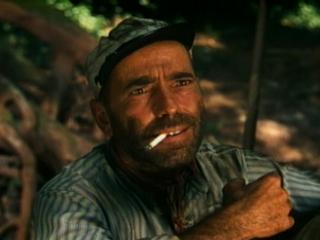
Released in 1951 and directed by John Huston, the film takes place in Africa during World War I and tells the story of an alcoholic boat owner (Bogie) who is persuaded by a missionary (Katharine Hepburn) to use his boat to sink a German warship.

There are so many reasons why I love The African Queen. It contains just about every element you'd want in a film (comedy, drama, adventure, romance, etc), it pairs Bogie with Katharine Hepburn, the color cinematography is beautiful and the story remains timeless to this day.


I think Bogie's role as Charlie Allnut really shows his diversity as an actor. Yes, his character is the "tough guy" he was most commonly known for playing, but it's different here because he's absolutely hilarious. The scene where he becomes intoxicated from gin and later when he attempts to imitate a hippo nearly made me fall out of my seat laughing the first time I watched it. Forget Marlon Brando, Bogie rightfully deserved the Oscar.


As with Bogie, this is also my favorite film and performance from Katharine Hepburn. Bette Davis was originally considered for Rose (she later dropped out because of pregnancy), but no one could have played her as well as Hepburn did. I do like Vivien Leigh, but I personally feel that the Academy made the wrong decision in the Best Actress category that year.


One of the best aspects of The African Queen is the chemistry between Bogie and Hepburn. It's so interesting to watch their relationship progress throughout the film- they start out as barely tolerating each other then end up in love by the films' ending. This was the only time they worked together, but they remained close friends for the rest of Bogie's life (she and Spencer Tracy were some of the last people to see him the night before he died in January 1957). 

**SPOILER ALERT**

The film was adapted from the C.S. Forester novel of the same name. I haven't read it, and I don't plan to, mainly because of different endings between the film and the book. If you've seen the (and if you read past the spoiler alert, I'm assuming you have), you know it ends as Charlie and Rose are captured by the Germans and married by the captain before execution. The Louisa then crashes into the remains of the African Queen and the torpedoes explode the ship, allowing Charlie and Rose to flee to the Belgian Congo. The book, however, ends as the Louisa is destroyed and Charlie and Rose go to inform the British Army. Honestly, I don't think I would like the film as much as I do if the ending hadn't been changed. I rarely say this, but I think this is one example of the movie being better than the book.


The African Queen was restored in 2009 for it's first release on DVD in 2010. I hadn't seen the film pre-restoration, but the video linked above shows comparisons between the two versions, and it's amazing to see how much the quality has improved. The color cinematography along with John Huston's direction is beautiful.

Overall, The African Queen is one of my favorite films and I hope it will be remembered 60 years from now just as it is today.


Friday, December 16, 2011

My Favorite Films: To Have and Have Not

In honor of the Bogie blogathon next week (I still can't believe it's only a week- I started planning this four months ago!), I'm writing another My Favorite Films post, this time on To Have and Have Not. 


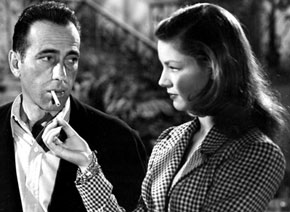
Released in 1944 and directed by Howard Hawks, To Have and Have Not tells the story of Harry Morgan (Bogie), an American expatriate living on the island of Martinique who is persuaded against his better judgment to help smuggle resistance members onto the island while flirting with a lounge singer (Lauren Bacall, in her film debut).

The film was adapted from the Ernest Hemingway novel of the same name, which is also considered the worst of his books (I haven't read it, so I can't give my opinion). The plot may not be the most unique, but it's the remarkable chemistry between the two stars that makes it so memorable.


This was the first of four films that paired Humphrey Bogart with his future wife Lauren Bacall, and it was a match made in movie heaven. With some actors, it's obvious that the chemistry between them is forced. With Bogie and Bacall, I sometimes forget I'm watching a film. All four of the movies they made together (the others being The Big Sleep, Dark Passage and Key Largo) are wonderful, but To Have and Have Not stands out the most for me because, if you're familiar with the romance between Bogie and Bacall, it makes you feel as if you're watching two people fall in love (and, in reality, you are).


The best (and most remembered) scene in the film is without a doubt in which Bacall says "You know how to whistle, don't you, Steve? You just put your lips together and blow." Every time I watch this, I'm astonished that she was robbed of an Oscar nomination, not just for this film, but in general. In 1997 she was nominated for Best Supporting Actress in The Mirror Has Two Faces and in 2009 received an Honorary Award, but she had so many great performances in the 40's and 50's that sadly weren't recognized by the Academy. 


Overall, I consider To Have and Have Not to be one of Bogie's best films, and I hope those of you that haven't seen it will check it out. It's airing March 5 on Turner Classic Movies for those of you interested. 
Unfortunately, this turned out shorter than I wanted it to be as I'm busy planning next weeks' posts, but I hope you all enjoyed reading it!


Friday, November 25, 2011

My Favorite Films: It's a Wonderful Life

Since most of my posts during the month of December are going to be Bogie-centeric, I wanted to take some time over the next week to talk about some of my favorite films to watch over the holidays. My all time favorite Christmas film (and one of my favorite films in general) is Frank Capra's It's a Wonderful Life.

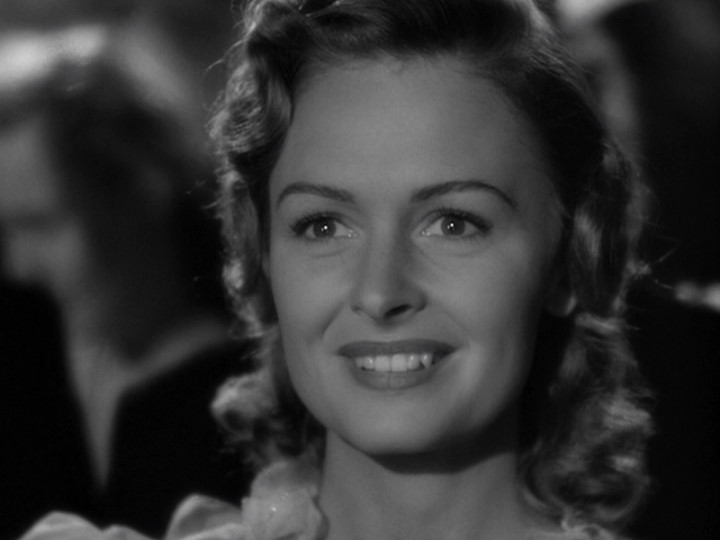
Released in 1946 and starring James Stewart and Donna Reed, the film tells the story of George Bailey (Stewart), a family man on the brink of suicide and feels that his loved ones would be better off had he never lived. George then receives a visit from an angel (Henry Travers) who shows him what the small town of Bedford Falls would have been like without him and makes him realize that his life is pretty wonderful, after all.

With certain films, there is one specific quality that makes it memorable. Sometimes it's the acting, the direction or the script. With It's a Wonderful Life, it's all these and more that make it the cinematic masterpiece it is today.

"Dear Father in Heaven, I'm not a praying man, but if you're up there and you can hear me, show me the way."

I'm always mesmerized by the talent that the actors posses, particularly James Stewart. Stewart was such a marvelous actor, and one thing that contributed to this was his ability to do well in any genre of film. He could do comedy (The Philadelphia Story), western (The Man Who Shot Liberty Valance) and thriller (Vertigo) with each performance being equally great. He often brings me to tears several times during the movie, but two scenes stand out the most for me: the first being the scene where George prays in the bar and the second when Harry toasts George as "the richest man in town". The emotions in It's a Wonderful Life are so real and effective. I dare you not to cry while watching it.  


Then there's Donna Reed, who is one of my favorite underrated actresses. Reed, like Stewart, also did well playing in versatile roles- here, she portrays the devoted wife and loving mother, yet she won her sole Academy Award playing a prostitute in From Here to Eternity. I also love the way she acts alongside Stewart, their chemistry together, especially in the telephone scene is unforgettable.

Also in the supporting cast are Lionel Barrymore as Mr. Potter and Thomas Mitchell as Uncle Billy. This is one of Barrymore's finest performances, even though he plays what was probably his most evil character. While Mitchell is seldom mentioned among popular actors today, he appeared in several iconic films- Gone With the Wind, Stagecoach (for which he won an Oscar) and High Noon, to name a few. It's nice to see him playing the comical character since this is definitely a dramatic film.


The film's screenplay was adapted from the short story The Greatest Gift written by Phillip Van Doren Stern. Doren unsuccessfully attempted to publish the story, and made it into a Christmas card instead. This attracted attention from RKO's David Hempstead, who mentioned it to Cary Grant's agent. In 1944, RKO bought the rights hoping to have Grant play George, he, however, went on to star in The Bishop's Wife instead (which I will be discussing in a blog post over the next few days).

Frank Capra then read The Greatest Gift and saw potential within the story. This is great because no one besides Capra could have made this movie as well as he did. The script is perfect- the dialogue pulls at the viewers' heartstrings without being too over-the-top (I personally think the term "Capra-corn" was undeserved). Capra's flawless direction only adds to the film. His camera shots are stunning, from the opening scene featuring a visual of "heaven" as the citizens of Bedford Falls pray for George, to the scene on the bridge where he contemplates taking his own life.

"...Every time a bell rings, an angel gets its wings."


In 2006, the American Film Institute named It's a Wonderful Life the most inspirational film ever made, and it is. Frank Capra's work continues to be a heartwarming story that sparks the dreamer in all of us and reminds the viewer not to take what life has to offer for granted. If you have yet to see this film, I hope you change that this holiday season.

Thursday, November 17, 2011

Review: The Rainmaker (1956)

IMDb Synopsis: Lizzie Curry is on the verge of becoming a hopeless old maid. Her wit and intelligence and skills as a homemaker can't make up for the fact that she's just plain. Even the town sheriff, File, for whom she harbors a secrect yen, won't take a chance --- until the town suffers a drought and into the lives of Lizzie and her brothers and father comes one Bill Starbuck ... profession: Rainmaker.


For no particular reason, I really enjoy watching films adapted from plays. Some of the best ones include A Streetcar Named Desire, 12 Angry Men and The Petrified Forest. The Rainmaker was adapted from the N. Richard Nash play and stars Katharine Hepburn and Burt Lancaster in the title role. A lot of reviews for this film are mixed, but I really enjoyed it.


I personally think a lot of people miss the point of The Rainmaker. The fact that it's a bit over-the-top and unbelievable at times it what gives it so much depth. Most of us have probably heard the term that you have to love yourself before anyone else can love you in return, and that's exactly what this film is about: Hepburn plays a repressed woman who fears she'll remain a spinster for the rest of her life, and Lancaster is the man who finally makes her believe in herself.


Some of the more skeptical viewers may find The Rainmaker to be unrealistic, but I thought it was quite lovely and inspiring. At least give it a viewing before you judge.


5/5 stars


Monday, October 17, 2011

Review: True Grit (1969)

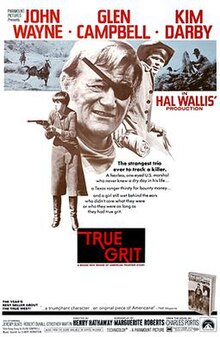
IMDb Synopsis: A drunken, hard-nosed U.S. Marshal and a Texas Ranger help a stubborn young woman track down her father's murderer in Indian territory.


If you saw my review of The Man Who Shot Liberty Valance, you know that I've never had a strong liking for westerns or John Wayne. I'll admit that I never really had interest in seeing True Grit until it was remade last year with Jeff Bridges and Hailee Steinfield.


With most westerns, I usually end up losing interest after the first half hour or so. With True Grit, this wasn't an issue. I actually found myself becoming quite engrossed as the story progressed. It's no surprise to me now that Wayne won the Academy Award for Best Actor in 1970- I'd say it ranks with Liberty Valance for being his best performance. I also was really impressed with Kim Darby. Now, I'm really interested in seeing the remake to compare it to the original.


Overall, I found True Grit to be a really enjoyable film. Even if you're like me and don't enjoy westerns, I would most definitely recommend viewing it.


4/5 stars


Friday, October 14, 2011

Review: Long Day's Journey Into Night (1962)

IMDb Synopsis: Author Eugene O'Neill gives an autobiographical account of his explosive homelife, fused by a drug-addicted mother, a father who wallows in drink after realizing he is no longer a famous actor and an older brother who is emotionally unstable and a misfit. The family is reflected by the youngest son, who is a sensitive and aspiring writer.


I don't even know how to start this review. I watched Long Day's Journey Into Night yesterday afternoon, and the only word I can think of to describe it is "Wow"- a film hasn't impressed this much since Judgment at Nuremberg.


Sidney Lumet and Katharine Hepburn really complete the film. I was completely blown away with Hepburn's captivating performance- if that's not superb acting, then I don't know what is (which she's the greatest actress of all time, so I'm not at all surprised). The same goes for Ralph Richardson, Jason Robards and Dean Stockwell, who all give quite impressive performances as well. This is one of the films where the whole main cast deserved Oscar nods.


One of my favorite directors as of late is Sidney Lumet (also known as the man behind masterpieces like 12 Angry Men and Fail Safe). I find his camera shots and cinematography to differ from other directors of the era, which brings a lot of depth to his films. I haven't read Eugene O'Neill's play yet, but I'm definitely going to now.


I can't enforce this enough: if you haven't seen Long Day's Journey Into Night yet, please do yourself a favor and change that.


5/5 stars


Saturday, May 7, 2011

May Noir of the Month: Double Indemnity (1944)

IMDb Synopsis: An insurance rep lets himself be talked into a murder/insurance fraud scheme that arouses an insurance investigator's suspicions.


This month, I'm going to be writing about one of the most popular film noirs of all time: Billy Wilder's Double Indemnity. Released by Paramount Pictures in 1944, it stars Barbara Stanwyck as sultry femme fatale Phyllis Dietrichson and Fred MacMurray as Walter Neff, the insurance salesman that gets caught in her web.


This film was based on a novella of the same name written by James Cain (one of his other novels, The Postman Always Rings Twice, was also adapted as a film noir in 1946 and starred Lana Turner and John Garfield). After it's publication in 1935, Cain sent copies of Double Indemnity to the major studios in Hollywood.  Shortly after, Warner Brothers, MGM, 20th Century Fox, Columbia and Paramount were all fighting to buy film rights. All the studios canceled their bids, however, after Joseph Breen from the Hays Office sent out a letter in which he warned:


"The general low tone and sordid flavor of this story makes it, in our judgment, thoroughly unacceptable for screen presentation before mixed audiences in the theater. I am sure you will agree that it is most important…to avoid what the code calls "the hardening of audiences," especially those who are young and impressionable, to the thought and fact of crime"- (taken from Wikipedia)


This was not unusual for Hollywood at the time, as the Hays Code had just been enforced the year before. Cain's original novel dealt with several elements, such as sensuality, adultery, and murder- things than had been almost taboo in motion pictures at the time. Eight years later in 1943, the script was edited and the rights were bought for $15,000 as a picture for director Billy Wider.


Double Indemnity was Wilder's third film as a director, and one of his best. He directed many film noirs including Sunset Blvd (my favorite noir of all time), Ace In the Hole, and Witness for the Prosecution. Some of his other triumphs include The Major and the Minor (his directing debut), The Seven Year Itch, Sabrina, and The Lost Weekend, the film that received Academy Awards for Best Picture, Best Director, and Best Actor for Ray Milland. 


I once heard someone say that Barbara Stanwyck seems almost "miscast as the femme fatale". This was because Stanwyck had never come close to a role like that of Phyllis Dietrichson. In fact, when Wilder offered her the role, she confessed to him that she was a bit frightened of playing a killer, to which he replied, "Are you an actress or a mouse?". He convinced her to play the part, and she later said in 1972 she had "been grateful to him since". I've seen several of Stanwyck's films, as she is one of my favorite actresses, and I think this was the best performance of her career. 


Other standout performances are from Fred MacMurray and Edward G. Robinson. MacMurray plays the man  seduced by Stanwyck into killing her husband, and Robinson is the one who discovers the secret behind their devious scheme. I haven't viewed many films starring either of these actors, but Double Indemnity is considered their best by many.


If I had to choose the one scene that stands out the most in the film, I'd probably say  the scene in which MacMurray murders Stanwyck's husband, played by actor Tom Powers. The murder is not shown, but the feel that Wilder and the actors give make it all the more real and suspenseful. (Unfortunately, I couldn't find it on YouTube, as I would have provided a link here.)


Double Indemnity is without a doubt an ultimate must-see for any classic film fan, and one of the best film noirs to come out of Hollywood in the 1940s. If you have not done so already, I highly recommend checking out this suspenseful masterpiece from Billy Wilder.


Wednesday, April 20, 2011

Review: Charade (1963).

IMDb Synopsis: Romance and suspense in Paris, as a woman is pursued by several men who want a fortune her murdered husband had stolen. Who can she trust?


Charade is directed by Stanley Donen, but is often referred to as "the best Hitchcock movie that Hitchcock never made"- and for obvious reason. The opening titles are very similar to those in Vertigo, while the cinematography and Donen's direction are both somewhat reminiscent of films like Rear Window and North by Northwest. 


I can't even begin to say how much I enjoyed watching this film. I think it's definitely Donen's finest work as a director and one of both Cary Grant and Audrey Hepburn's best films.


Grant and Hepburn both delivered marvelous performances. Anyone who doesn't like Audrey Hepburn's acting should really give this film a try before judging her only by Breakfast at Tiffany's and My Fair Lady (Both of which are films I dislike.) The chemistry they had together is part of what really makes Charade a wonderful movie, and I really wish they had worked together more than once.


Screenwriter Peter Stone deserved an Oscar for the script. Every bit of dialogue is both witty and clever. I can honestly say that the story kept me guessing throughout the whole film and I was genuinely surprised by the ending (which I won't spoil).


Charade is among my picks of the best thrillers of all time, and one of the best films to come out of the nineteen-sixties. I'm willing to bet that any Hitchcock (or classic film) fan would enjoy this gem from Stanley Donen.


5/5 stars

Academy Awards, 1964:
Best Music, Original Song Nominee

Tuesday, April 5, 2011

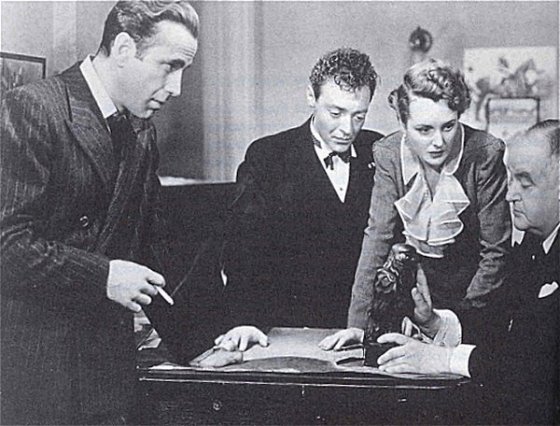
April Noir of the Month: The Maltese Falcon

IMDb Synopsis: A private detective takes on a case that involves him with three eccentric criminals, a gorgeous liar, and their quest for a priceless statuette.


When I first started my 'Noir of the Month' series in January, I already predicted that there would eventually be a post on one of my all-time favorite films, The Maltese Falcon.  Released in 1941, the film stars Humphrey Bogart, Mary Astor, Sydney Greenstreet, and Peter Lorre; directed by John Huston.


Falcon is remembered for a large number of reasons- it's considered to be the grandfather of film noir, it marks John Huston's directing debut as well as Sydney Greenstreet's acting debut in an Oscar-nominated performance, and it features Bogie as Sam Spade who gives some of the most memorable quotes in film history, including "The stuff that dreams are made of" and "I don't mind a reasonable amount of trouble". 


This is actually the third screen adaption of the novel  by Dashiell Hammett- there were two previous versions- the 1931 pre-code of the same name and the 1936 film Satan Met a Lady. I've seen neither, but I've heard they should both be skipped. 


The performances in this film are absolutely incredible. Bogie should have at least gotten an Oscar nom for his work, along with Mary Astor for Best Supporting Actress (although she won the award that year for The Great Lie). The lead performers are also well accompanied by Sydney Greenstreet and Peter Lorre (Trivia- Lorre stated this was his favorite of all his films).


I absolutely must say a few words about the directing: Huston's work is just marvelous. I actually was shocked when I found out this was his first film. The effects, camera shots, and lighting in The Maltese Falcon rank him with directors like Alfred Hitchcock and Otto Preminger.

I think we can all agree that The Maltese Falcon really is "the stuff that dreams are made of."


Sunday, April 3, 2011

Review: The Grapes of Wrath (1940)

IMDb Synopsis: A poor Midwest family is forced off of their land. They travel to California, suffering the misfortunes of the homeless in the Great Depression.


This seemed to be one of those "everyone's seen it but me" films. And there is a darn good reason almost why everyone has seen The Grapes of Wrath: it's a masterpiece and one of the best films I've ever seen.


It seems to me that all of the films adapted from John Steinback's novels have marvelous male leads. Henry Fonda gives a flawless performance, as did James Dean in East of Eden, fifteen years later. The whole cast itself is amazing, including Russell Simpson and Jane Darwell as Pa and Ma Joad (Darwell actually won an Academy Award for Best Supporting Actress in 1941).


I can honestly say that The Grapes of Wrath is one of the best and most inspiring films I've ever seen. Do yourself a favor and check out this flawless classic from director John Ford.


"Takes no nerve to do something, ain't nothin' else you can do." - Tom Joad (Henry Fonda)

5/5 stars